A gift is a guess about her, and a wrong guess is repairable in two days by somebody willing to say one plain sentence first.
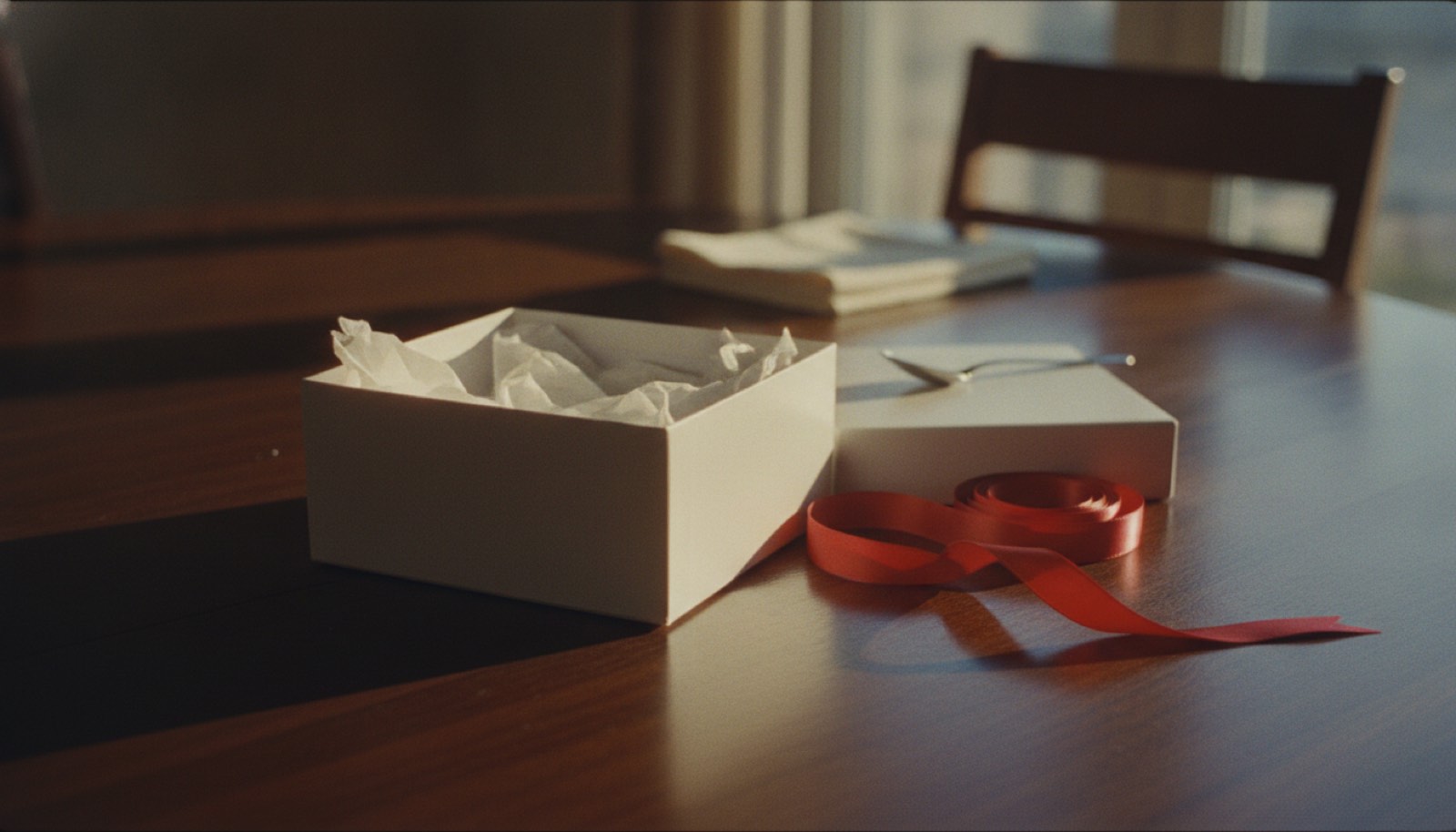
She opened it, she said thank you, and you could hear her working to make the thank you sound right. Maybe she managed it and you still watched her face do one thing while her mouth did another. Either way you know, and there's a whole evening left to get through.
Your instinct right now is probably to explain the gift. Where the idea came from, what it cost, why you were sure. Hold that, because the next two days have a better use, and it has nothing to do with defending the receipt.
A gift is a guess. You take what you know about her, you bet it on one object or one plan, and you find out how good the bet was by watching her open it. There's no version of that with the risk removed.
When the guess is wrong, the mistake is a narrow one. You got one preference about her wrong. That is the entire size of it, and it stays that size unless the next two days make it bigger.
It won't feel narrow tonight, because you bought it for the anniversary, which is the one day a year that's supposed to prove you've been paying attention. So the miss gets taken as evidence about the marriage instead of evidence about a sweater.
I sell a dance program that people buy for each other as gifts, so the ones that flop come straight back to me in writing. One customer's message opened like this:
"I honestly hate to do this, and I completely understand if it's not possible."
The same email laid out what had happened:
"I paid for the dance lessons as an anniversary gift, even though we're on a veeerrrry tight budget, thinking it would be romantic and fun. Well, my wife thought differently. She was super upset that I spent $67 without consulting her first."
Another customer cancelled an order with two sentences:
"Unfortunately my wife was not into this idea and wishes not to proceed. I have not viewed anything yet as she was not excited about the gift."
A third one, shorter still:
"I purchased as a gift for my wife and she isn’t interested in learning to dance at this time."
Only the first of those says it was an anniversary. The other two don't say what the occasion was and I'm not going to invent one. All three bought an experience for a wife, one with both of them in it, and all three got a reaction they weren't expecting.
The gift in every one of those emails was mine. Date Nights Dancing is easy swing taught at home, fifteen minutes at a time, both of you following the same video from the beginning. No dance experience required. So I'm not writing this from a safe distance: the flop you're sitting in tonight is one I've read more than a few versions of.
In The Power of Moments, Chip Heath and Dan Heath make the case that we don't score an experience by averaging its minutes. We remember the flagship moments, "the peaks, the pits, and the transitions," and we rate the whole thing by its best or worst moment and by how it ended.
A pit is a negative defining moment, and their instruction for it is four words: "Pits need to be filled". Fill the pit first, then go build something good. Skipping to the good part while the pit is still open is how people spend money and change nothing.
Which means buying her a second, better present tomorrow is the wrong answer, however much your hands want to. The second present covers the pit instead of filling it, and she'll know what it's for.
The Heaths also point out that "pits can sometimes be flipped into peaks". That's not a promise, and they'd be the first to say it isn't automatic. But the ending of this anniversary is still unwritten tonight, and by their account the ending is half of what she'll remember it by.
Two days isn't a scientific window, just roughly how long you have before neither of you brings it up again. Do these in order.
You go first. Not tomorrow, and not after she decides whether it's worth bringing up.
If you want to try it, you might say something close to this: "I got that wrong. I bought you what I wanted to give you instead of asking what you'd want."
Then stop talking. You'll want to keep going: the price, the reasoning, the shipping date, the friend who recommended it. Every one of those sentences is a defense of the guess, and she isn't arguing with the guess. She's telling you something about herself.
In I Hear You, Michael S. Sorensen names that reflex as the most common one there is: "jumping straight to advice or assurance remains the number one temptation for, well, just about everyone." He's writing about listening in general. It applies with force to the man holding a gift receipt.
There was a question you didn't ask, because asking it would have cost you the surprise. Ask it now, when there's nothing left to spoil.
Sorensen's opener is short enough to say without rehearsing: "How are you feeling about all this?" His rule for what comes after has two parts: name the specific emotion you think she's feeling, and give a reason it makes sense that she feels it. Not agreement. Just the reason.
So if the money is what stung, say the money is what stung, and say that anybody working from a tight month would feel it. If it was being handed a plan she had no say in, say that. Then ask the real question: "What would you have picked, if I'd asked you first?"
Her answer is the most valuable thing you'll get out of this week. Don't correct any part of it, don't rank it against what you bought, and don't start solving it while she's still talking.
Pick a date inside the next two weeks, put it in both phones, and let her decide what happens on it. She chooses, you handle every piece of the arranging. If her answer in part two was a specific thing, that answer is the plan and you don't need a second idea.
The customer with the $67 receipt had already run a version of this before writing to me:
"I convinced her to give it a try, and we watched the first couple videos and danced a little. But we haven't gone back to check out the later videos as they are now a point of contention (sigh)."
I don't know how that one ended. But it shows the limit of the do-over: one good evening doesn't settle an argument that was never about dancing. The problem in that house was $67 out of a tight budget without a conversation first, and no amount of dancing answers that. If money is the live wire in your house too, the tight-budget anniversary piece is the more useful read tonight.
She has probably already told you what she wants. If she has, it came out in passing, months early, in a tone that didn't sound like a request, which is why it went past you. The full method for catching those is on the birthday date night page.
One thing worth adding, because it's specific to what you just bought. An experience gift asks more of her than a sweater does. She has to give up an evening, and she has to be a beginner at something in front of you. Hand it over finished, with the money already spent, and she has to accept both of those before she's said yes to either.
The fix is small. Give the experience as an invitation with a date attached instead of a done deal, and open it together on the night rather than emailing her an access code and hoping. That's how I'd rather you give the Date Nights Dancing program: the two of you on the couch, first video, nobody ahead of anybody.
There's more on that whole category on the experience gifts page, and if her reaction was closer to "this looks like something you want," there's a piece on that exact reaction.
Say the sentence tonight. Ask the question tomorrow. Get the date in both phones before the weekend is over, with her choosing what happens on it.
None of that costs anything, and all three are worth more to her than the object was, because they're the parts she can't buy herself.
If you want the wider list for the occasion itself, things to do on an anniversary covers the evening side of it, and everything else lives on the ideas hub.
You aimed at something she'd feel instead of something safe, and that's the harder thing to do by a distance. The gift card was sitting right there, and it would have kept the guess out of it. The aim was right. The information was incomplete, and she just gave you the rest of it.
The Thursday reminder over 100,000 couples love: ideas and conversation starters that deepen love, laughter, and intimacy.
