Five theme nights you can run in your own living room, with what to build for each one and what it changes about the evening.
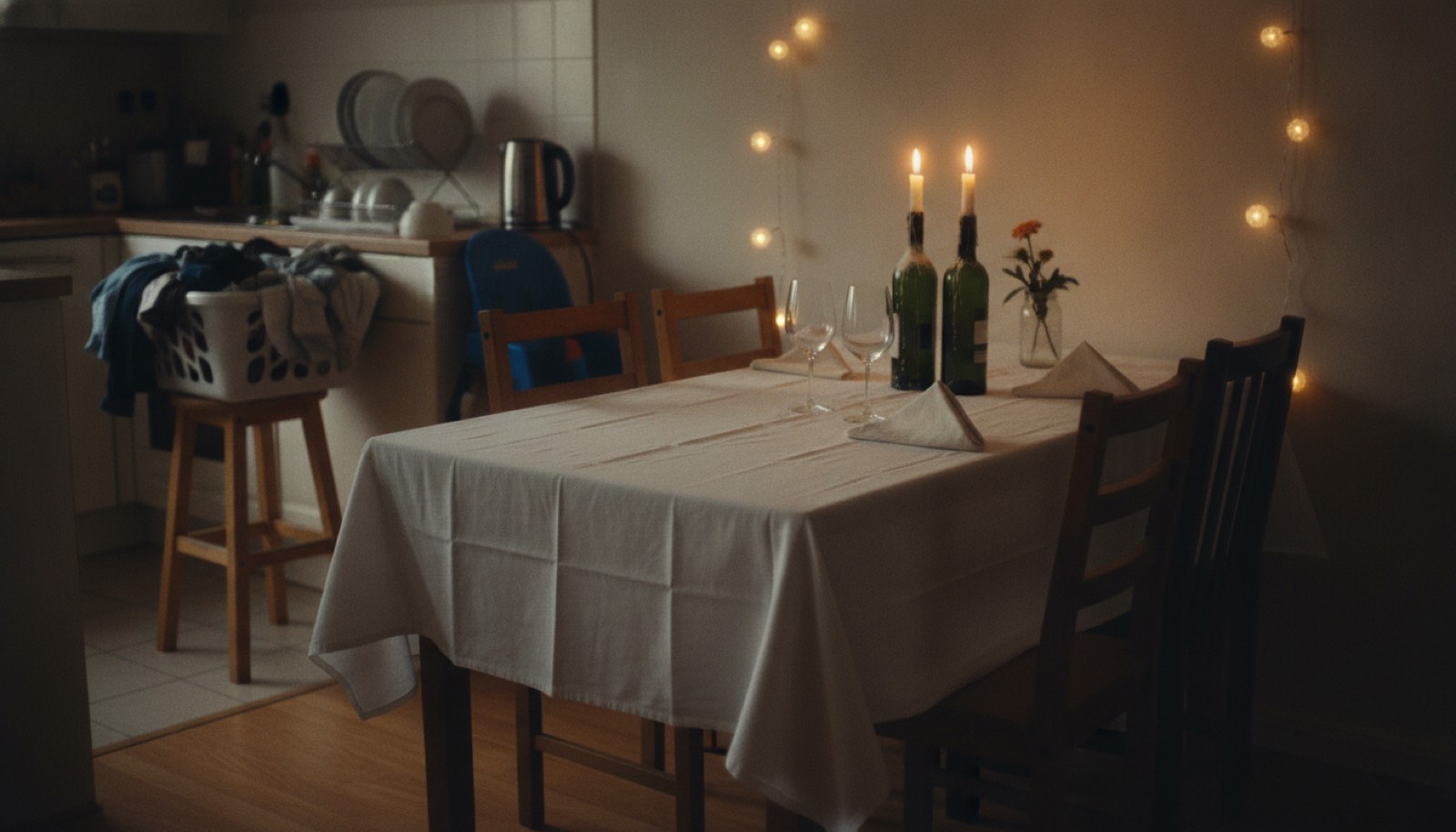
You've run game night. Movie night too, more than once, and the last one you both half-watched with a phone going. Nothing is wrong with either of them. They've just been around enough times that the two of you can call the whole evening from the first ten minutes of it.
If you wrote down the last four things you and your wife did together after dinner, how many would be reruns?
A theme is the cheapest way I know to change that, and it works on a different part of the evening than a new activity does: the light in the room, what you're both wearing, what's playing, the order things happen in. Same house, different world, and the switching is most of the fun. If your standing night is the thing that's gone flat rather than any one evening, there's more on keeping that night from going stale elsewhere on the site.
In The Power of Moments, Chip and Dan Heath explain why some experiences get remembered and most don't. They give three ways to build one: "First, boost sensory appeal. Second, raise the stakes. Third, break the script." Most memorable moments have two of the three. They don't need all of them.
Breaking the script is the one that does the heavy lifting at home. Familiar and memorable pull against each other. Nobody cherishes the memory of their last meal at McDonald's, and the meal wasn't bad. The script just ran perfectly. Your Friday night has a script too. Both of you know it by heart, which is exactly why neither of you can remember last Friday.
A theme is a script break you can set up in twenty minutes with things you already own. The sensory part comes along with it for free, because a theme tells you what to change about the light and the sound and the clothes, which is the part most guys skip when they just pick a new activity.
The Heaths also name the thing that kills these before they happen. "Beware the soul-sucking force of 'reasonableness.'" The second version of any plan is always the sensible one. You drop the outfit, you leave the overhead lights on, you keep the phone on the counter in case, and what's left is a normal evening with a label on it. Whatever the strange detail is in the theme you pick, that detail is the theme. Keep it.
Dancing in your own living room breaks the script of every evening she's used to, which is what Date Nights Dancing is. It's easy swing taught at home, fifteen minutes at a time, the two of you starting at the same point. No studio and no experience needed.
Nothing below is a board game and nothing below is a film. If either of those is the rotation you'd rather deepen instead, the game night ideas and the movie night ideas are their own lists, and they're good at what they do. What's here changes the room instead of the activity. Each one has a world, a short build list, and something to play, and none of them need anything you'd have to think twice about buying.
Pick a decade the two of you have some feeling about. The one you were in high school in, the one her parents' music came from, the one you both keep watching movies out of. Then commit to it for one evening: the music from it, one thing you learn from it, and clothes pointed roughly in its direction.
A woman left this on one of my ads:
after the kids were sleeping , my husband and I were watching It’s a Wonderful Life and decided we wanted to learn the Charleston. We YouTubed it and had so much fun dancing and laughing.
They weren't customers of mine when they did that. There was nothing else to it, and it's the one I'd start with.
Build list:
Another comment, on a different ad, gave the whole thing a name:
My wife and I have “ sock hops”.
Two words, and the evening has a shape. That's most of what a theme is doing for you.
One night, your dining room is a restaurant, and the restaurant has a name. Take the name from your own history: the street of your first apartment, the town you got engaged in.
Build list:
The food is not the point here, which is why this works on a night you're reheating something. If the cooking itself is the part you want to be doing together, that's its own kind of night.
Same meal, reverse order. Dessert first, at the table, on the good plates. Then the main. Then the salad. Then the drink you'd normally have started with.
It sounds like a gimmick until you're eating the best part of the meal at seven o'clock instead of at nine when you're full and half asleep. The reversal also breaks the conversation open, because the first ten minutes of a meal are usually logistics and you've now spent those ten minutes eating pie.
Build list:
Three versions of one cheap thing, tasted blind, argued over. This is the purest version of boosting sensory appeal, and it costs one aisle of the grocery store.
Build list:
Three chocolates can hold a table longer than you'd expect them to.
The whole house goes dark for this, not just the dining room. Candles and one flashlight, one album played front to back in order, and nothing else running anywhere.
Pick the album carefully, because an album ends. It gives the evening a shape and a finish line, and the two of you are less likely to drift toward separate screens when there's a side B still to get to.
Build list:
In warm months this one is better outside than inside, and there's a whole set of backyard and porch versions that use the same idea with string lights instead of candles.
Pick the theme yourself and don't hand her the choosing. Asking her which theme she'd like turns your surprise into one more decision on a day that's already been full of them, and the deciding may be the part she's tired of.
Tell her the night and the name of it, and not much else. If you want to try it, you might say something like this:
"Thursday's the restaurant. It's called Delaney Street. I've got it handled, you just have to be hungry at seven."
The build list is the whole prep. Twenty minutes while she's out, or after work with the door shut. One hour of actual evening is plenty for any of these, and the ones with a fixed length built in, the album, the flight, a set of songs, will end themselves before either of you has to decide whether it's over.
Then run the strange version. On the day, you'll want to drop the outfit or leave the kitchen light on. That's the reasonableness the Heaths warned about.
If inventing a new world every week is the part that stalls out, that's a fair argument for working through something together instead, and it's one reason the Date Nights Dancing program fits couples in this exact spot. The next video is already picked, it's fifteen minutes, and it happens in your own living room. If you'd rather keep building the nights yourself, there are plenty more at-home date night ideas to pull from.
The one that made you picture your own house is the one to run first. The others will still be here in three weeks.
The couple who ended up learning the Charleston after their kids were asleep weren't running a system. A movie put an era in the room and they followed it, and that's the night one of them wrote about under a stranger's ad. You need one evening where the room is different from every other room your marriage has been in this month.
For what it's worth, plenty of men never get as far as reading a list like this one. Wanting the evening to be an event rather than a rerun is the instinct the whole thing runs on. Nothing about the house has to change for the evening to happen somewhere else.
The Thursday reminder over 100,000 couples love: ideas and conversation starters that deepen love, laughter, and intimacy.
